
One Hundred Years of Solitude (the book)
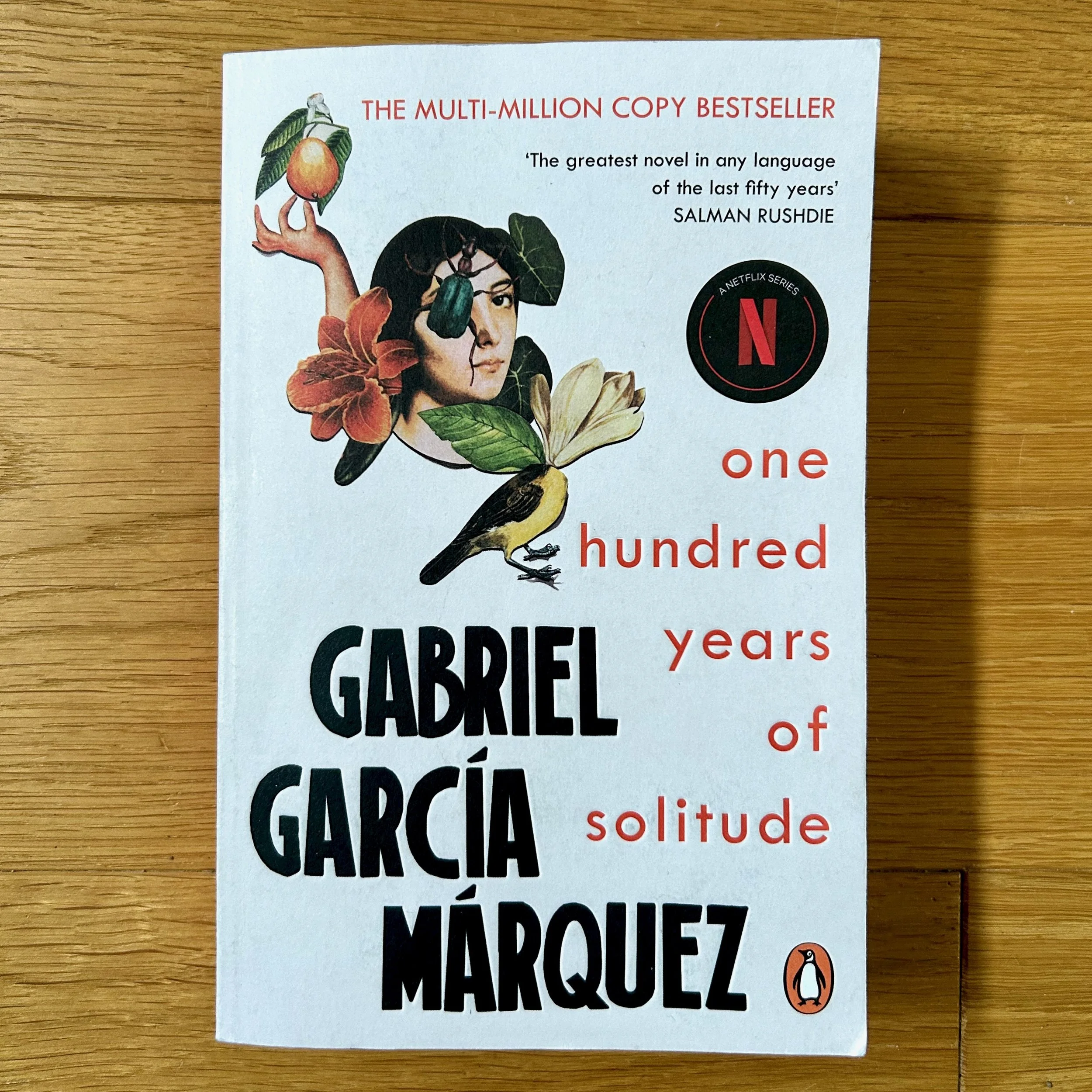
One Hundred Years of Solitude by Gabriel García Márquez
I set out to include this in my recent book reviews list, but then it grew to epic proportions. So it has its own post.
The reason I decided to read this book is one of the silliest reasons I have ever read a book. Perhaps. I’d heard of it of course. It is supposedly “the greatest novel in any language” according to a quote on the cover. I’ve heard many jokes and references to it on television shows. And Márquez won a Nobel Prize in Literature in 1982 most likely in particular for this novel. But I never really bothered to look it up.
And then sometime this year I saw a poster in a friend’s house that I just loved. It was a Penguin cover for this novel with a painting by Hungarian contemporary artist, Tamas Galambos. Something about the painting just really grabbed me. I kept thinking about it. It’s so illustrative and vibrant. It looks like a storybook village I want to live in. And then our friends moved and offered us the poster! She remembered how much I had liked the poster. I almost immediately decided on a good place for the giant poster in our new extension, but have not hung it yet as we still have a couple of details to finish in that room that will affect the placement of the poster.
But it was also bugging me that I was going to hang a poster in my house for a book that I had never read. I just couldn’t do it. (Even though it is only a portion of a painting that has nothing to do with the book anyway.) So, on a recent trip to Oxford, while we were perusing multiple bookshops, I searched for a copy of the book. It was harder than I thought it would be. And unfortunately, the Penguin edition with the beautiful cover is trickier to find than I realized. And some of the covers were just awful. I finally found this passable version in the incredible Oxford Blackwells and dove in.
I just finished it this morning… and I didn’t love it. It’s 422 pages that felt like one hundred years. Ha! But let me slow down and recap.
One Hundred Years of Solitude is about the Buendía family. Seven generations of them. Or another way to say it is one hundred years of them. It is a strange novel set in a mythological country that is likely inspired by Márquez’s Colombia. The characters tend to name their children after family members so the names and characters easily become confused. (Can we just talk about the 17 Aurelianos in one generation!) It is a story of generational trauma, history, politics, and relationships, with a really odd layer of magical realism.
I’m not going to dive too deep into a review because I know I won’t do it justice for the many reasons it helped win Márquez the Nobel Prize and I am probably missing something about the Colombian cultural influence, or the lost in translation bits that I always wonder about, or even the magical realism which I’ve not read enough of. So if you know it and love it and want to talk details, let me know. I always prefer in person with a cup of coffee anyway.
My main takeaways are two-fold. One, it reminded me of Encanto. If you don’t know and love that Disney film, you won’t get it; but from start to finish, all I could think about was how many elements of Encanto were clearly inspired from the Buendía family and their mythical town of Macondo. Heroic patriarchs fleeing and founding and caring for the town, family members with odd magical or miraculous experiences, a house that changed and broke with the family, fighting or ostracized family members, mysterious prophesies, exotic animals, and even yellow butterflies and flower petals. I could go on. I even started mentioning little elements to my girls occasionally and they would immediately say, “that’s like Encanto!” again and again. But let me be clear, Encanto is the Disneyified, child-friendly inspired version of Márquez’s story. One Hundred Years of Solitude contains so many adult-only elements I contemplated putting it down at least a couple times. We’re talking violence, affairs, murders, incest, prostitution, and I’m sure I’m gladly forgetting something. This isn’t a tame novel and yet, none of those elements were romanticized at all. It is a very human story about 7 generations of a dysfunctional family and you feel all the ups and downs of their life, decisions and the clear generational mistakes and traumas that follow all of them. It’s rather heartbreaking to be honest.
And that leads to my second takeaway. I will never understand someone having the skill and passion for writing and crafting great stories and then doing so to make a depressing and unhappy story. The world is hard enough without artists telling stories that leave you in the pits of despair. It is likely Márquez’s bleak worldview, but there is no redemption for any member of the Buendía family. And there’s hardly any happiness. But there’s loads of solitude! And all mostly solitude by choice. I should have counted the number of times that word solitude appeared because it definitely triggers something to read it as you are trying to figure out where the book is headed. No spoilers, but it all just ends. And while the ending is unique, memorable and strangely magical, it’s depressing. It left me wondering if any of these characters had any choice at all. They just seemed to follow patterns of the family decisions and some sort of prophesy or curse. You don’t ever really get attached to any of the characters, partly because they are so openly flawed and the names are confusing and so intertwined; but also, Márquez doesn’t give you enough of any character to really understand them and love them, flaws and all. The closest I got was to the matriarch of the family who lived an extraordinarily long time and helps tie a lot of the story together.
I love a good, hard read and even ones that make me cry for happy or sad reasons. But I don’t believe it is all meaningless and I certainly don’t think people are just products of their family and a culmination of their decisions. I also would have loved more of the magical realism. But that will always be my fairy tale and science fiction bent. There could have been so much more in this interesting framework of a story and family. And I guess that’s the piece that I do love – it’s obvious relation to Encanto. I love that the writers and creators of Encanto saw the cool structure in One Hundred Years of Solitude and they took it and ran with it. It’s not the same, but it is clearly inspired. And in my opinion, it does it way better. How desperately sad of a movie Encanto would have been if it ended with Mirabel in Bruno’s room with the full vision and the house crumbling. That’s basically where this novel wraps up. I’m so grateful for creators that take a cool story and an interesting family, reveal their flaws and then reveal the thread that leads to redemption that was there all along. That’s beauty. And what else does art exist for but to add to the beauty?
So I guess time will tell how much this book stays with me. I’m certainly not sad to have read it, though there are so many interesting books begging for my time around my house. And it gave me lots to think about, especially in relation to Encanto and being inspired by brokenness and turning it into something beautiful. And I am glad that I saw Encanto first instead of reading this, but maybe that is the wrong way around.
But I will hang that beautiful poster where I’m intending. And I will remember our friends who gave it to us. And I’m looking forward to talking about it if and when it comes up. I’m always up for a good redemption story… even if it ends outside the book.
As always, thanks for reading. 💚
P.S. I’m definitely not the only one to see the Encanto connection. I looked it up to see if the writers had mentioned it or anything in an interview and came across a few bloggers talking about it. I enjoyed this post a lot, especially coming from the reverse perspective of having read the book and then seeing Encanto. And I loved his description of Encanto as the theme park and the novel as the freakshow. Sounds about right.